| Research |
 |
Location:Home > Research > Research Progress |
| Probabilistic Storm Surge Forecasting in the Bohai Sea: A Major Breakthrough by Yantai Institute of Coastal Zone Research |
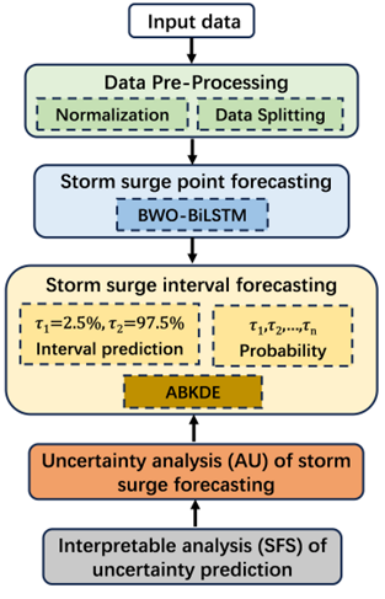
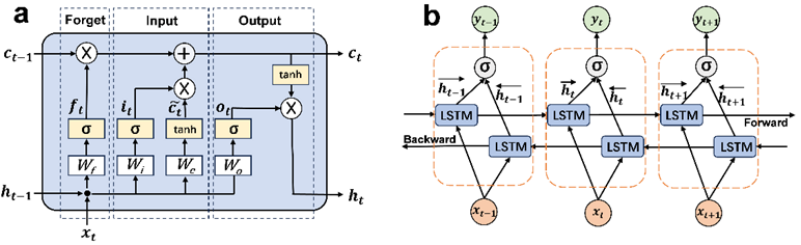
Probabilistic Storm Surge Forecasting in the Bohai Sea: A Major Breakthrough by Yantai Institute of Coastal Zone Research Storm surge is one of the major marine disasters in coastal regions. Current mainstream storm surge forecasting approaches are dominated by deterministic forecasting, while fail to fully exploit and quantify the uncertainties inherent in the prediction process, making it difficult to meet the refined early warning requirements for marine disaster prevention and mitigation. To address this critical issue, the Coastal and Estuarine Physical Oceanography (Prof. Miaohua Mao’s research team) at the Yantai Institute of Coastal Zone Research, Chinese Academy of Sciences, has carried out targeted research and successfully developed a deep learning framework for probabilistic storm surge forecasting tailored for the Bohai Sea (Figure 1). The team established an interpretable hybrid modeling system integrating Bidirectional Long Short-Term (BiLSTM), Adaptive Bandwidth Kernel Density Estimation (ABKDE), and Sequential Forward Selection (SFS) (Figure 2). This work provides a novel, high-precision, and interpretable probabilistic forecasting solution for storm surge disaster risk assessment and early warning issuance, representing an important breakthrough in uncertainty quantification and accurate forecasting of storm surges in the Bohai Sea.
Figure 1. Overall framework of the probabilistic storm surge forecasting model
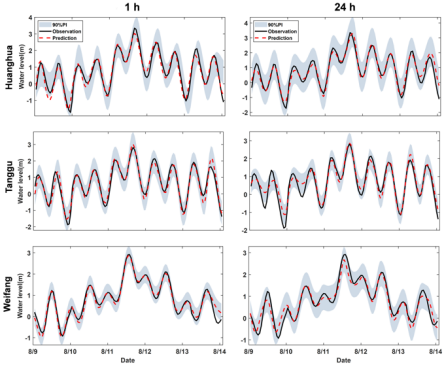
Figure 2. (a) LSTM and (b) BiLSTM models The core innovation of the probabilistic storm surge forecasting model constructed in this study lies in the optimization of traditional forecasting methods and the organic integration of multiple techniques. The ABKDE method, with its adaptive bandwidth adjustment mechanism, effectively overcomes the inherent limitations of conventional baseline methods, such as insufficient tail-fitting accuracy and blurred depiction of local details. The integrated BiLSTM-ABDKE model successfully resolves the challenge of fitting non-Gaussian residuals, substantially improving the overall performance of probabilistic storm surge forecasting. Validations show that the point predictions of the model can accurately track the macroscopic evolution of storm surge water levels. When constructing 90% prediction intervals, the model steadily achieves both higher interval coverage and narrow interval width, exhibiting adaptive characteristics of contraction during steady phases and widening during rapid fluctuations, thereby realizing high-quality and precisely quantified forecasting of storm surges in the Bohai Sea (Figure 3).
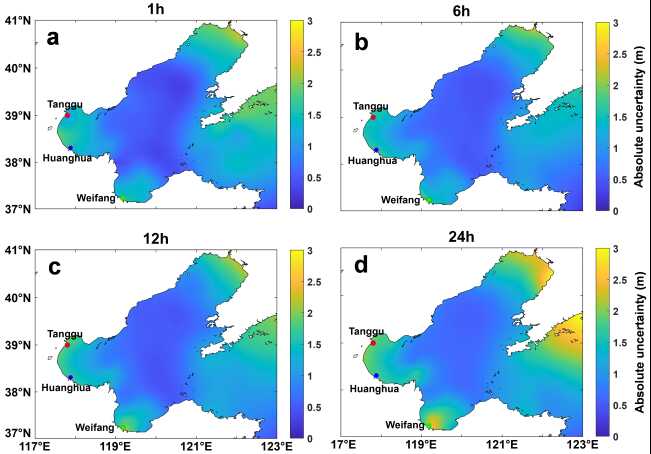
Figure 3. 1 and 24-h interval predictions (90% CI) of storm surge based on BiLSTM-BAKDE The research team further revealed the spatial distribution and spatiotemporal evolution of forecasting uncertainties for storm surge in the Bohai Sea. The overall uncertainty of storm surge forecasting in the Bohai Sea is relatively low, with high-value zones concentrated mainly in the coastal zone and nearshore shallow waters of the three major bays, while the central basin maintains low values with gentle spatial gradients (Figure 4). Affected by the combined effects of the funnel-shaped bay topography and strong nonlinear hydrodynamic processes in shallow waters, Tanggu Station at the top of the bay emerges as a hotspot of high uncertainty, with absolute uncertainty levels significantly higher than those in the open central basin. As the forecast lead time extends to 12 and 24 hours, the uncertainty level across the entire Bohai Sea increases markedly, and the amplitude and spatial extent of high-value zone along the coast and within the bays expand synchronously and radiate offshore. This pattern mainly arises from the continuous accumulation and amplification of meteorological input errors with increasing forecast lead time. Specific waters such as the Liaodong Bay, modulated by water mass accumulation and delayed dynamic responses, show more intense uncertainty expansion in long-lead-time forecasts.
Figure 4. Spatial distributions of absolute uncertainty (AU) in storm surge forecasting for the Bohai Sea at forecast lead times of (a) 1 h, (b) 6 h, (c) 12 h, and (d) 24 h Meanwhile, the study preciously identified “central pressure-maximum wind speed-latitude” as the optimal feature combination for Bohai Sea storm surge forecasting and clarified the physical driving mechanisms of each feature. Maximum wind speed and central pressure form the energy basis for storm surge generation, while latitude imposes core constraints on hydrodynamic phases, acting as key spatial switch governing the “filling (onshore water increase)” and “empty (offshore water decrease)” states of the Bohai Basin. The introduction of the latitude factor effectively eliminates ambiguities in local flow field phases, reducing the global prediction uncertainty by approximately one-third. Longitude, which carries high information redundancy with latitude tracks, contributes minimally to the physical constraints of the model and was not selected in the optimal feature set. This conclusion provides an important scientific basis for feature selection in storm surge forecasting. The interpretable hybrid modeling framework developed in this study not only delivers more comprehensive and informative predictions for probabilistic storm surge forecasting but also transforms prediction uncertainty into key information supporting early warning decision-making. It can significantly enhance the scientificity and efficiency of storm surge disaster early warning, providing vital technical support and scientific references for marine disaster prevention and mitigation as well as integrated coastal zone management in coastal regions. The research results have been published in Estuarine, Coastal and Shelf Science, a prestigious journal in the field of estuarine and coastal research, under the title “Probabilistic storm surge forecasting in the Bohai Sea: A deep learning framework with adaptive uncertainty quantification”. This work was supported by the National Natural Science Foundation of China, the Chinese Academy of Sciences, Shandong Province. Related Paper Information: Su C., Mao M.*, 2026. Probabilistic Storm Surge Forecasting in the Bohai Sea: A Deep Learning Framework with Adaptive Uncertainty Quantification. Estuarine, Coastal and Shelf Science. 336, 109877. Su C., Sahoo, B.*, Mao, M., Xia, M., 2025. Machine Learning Techniques for Predicting Typhoon-Induced Storm Surge Using a Hybrid Wind Field. Journal of Geophysical Research: Machine Learning and Computation. 2, e2024JH000507. |
| Appendix Download |
|
|