| Research |
 |
Location:Home > Research > Research Progress |
| Yantai Institute of Coastal Zone Research Makes Progress in Studying the Impact of Precipitation Variation on Carbon Sequestration Function in Coastal Wetlands |
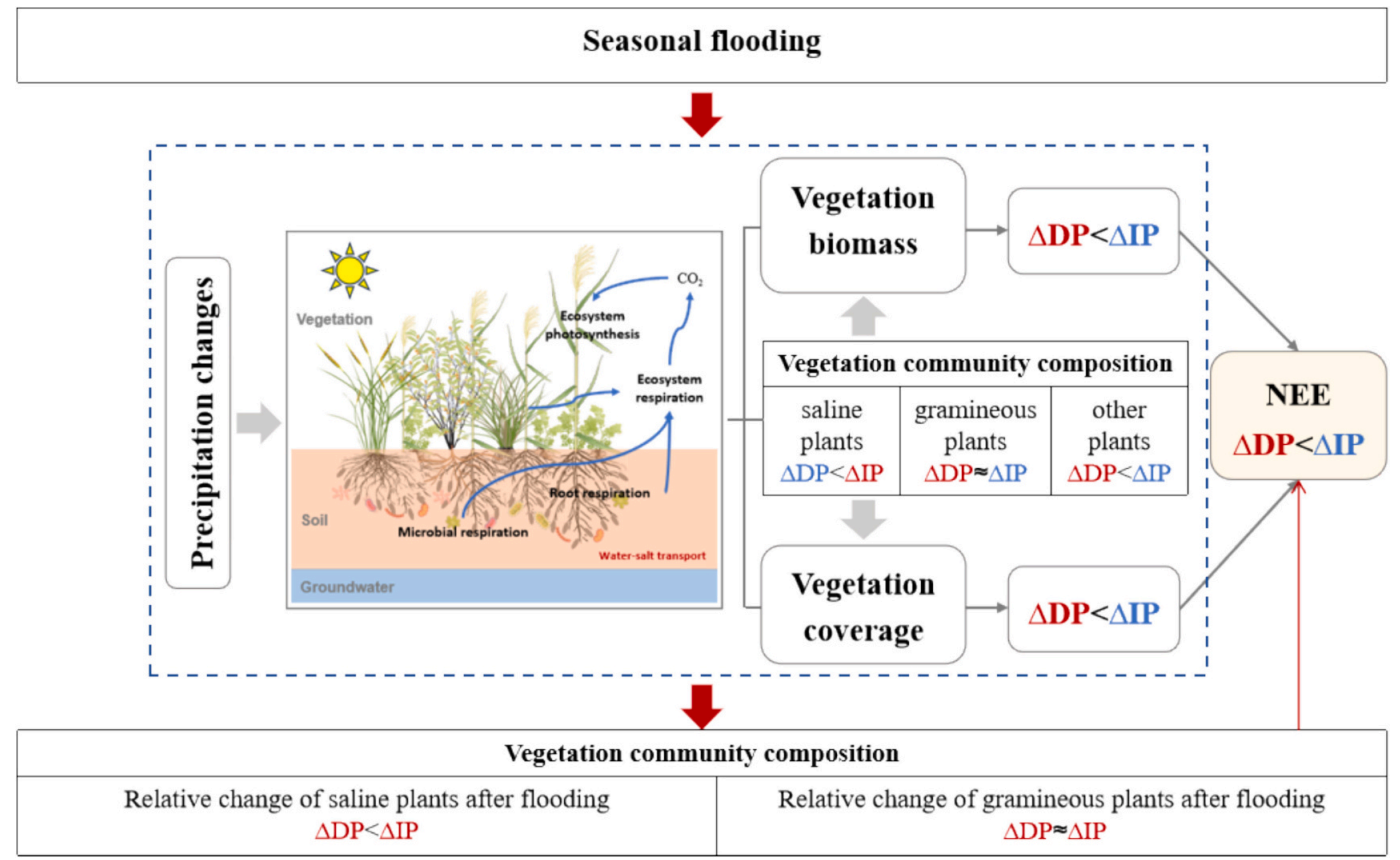
Under the background of global climate change, interannual precipitation has exhibited substantial variability in terrestrial ecosystems. As important terrestrial carbon sinks, wetlands play a critical role in regulating atmospheric CO₂; however, how their carbon sequestration capacity responds to altered precipitation remains highly uncertain. Recently, the Coastal Wetland Evolution Mechanisms and Ecological Restoration Research Group at the Yantai Institute of Coastal Zone Research, Chinese Academy of Sciences (Guangxuan Han Research Team), addressed this core scientific question based on the long-term precipitation manipulation platform at the Yellow River Delta Ecological Research Station of Coastal Wetland, Chinese Academy of Sciences. Using five precipitation treatments (-60%, -40%, ambient precipitation as control [CK], +40%, and +60%), the team conducted a decade-long field experiment to systematically elucidate how altered precipitation influences net ecosystem CO₂ exchange (NEE) and soil organic carbon (SOC) content and stability in wetland ecosystems. The study further analyzed how seasonal flooding regulates the responses of NEE, gross ecosystem production (GEP), and ecosystem respiration (ER) to precipitation change. The results demonstrated that ecosystem carbon fluxes exhibited a significant positive asymmetric response along the precipitation gradient, with the stimulatory effects of increased precipitation exceeding the suppressive effects of reduced precipitation. Compared with the control, the -60% treatment slightly reduced GEP and ER by 9.7% and 9.3%, respectively, whereas the +40% and +60% treatments significantly enhanced GEP, ER, and NEE. This asymmetric response primarily resulted from the relatively minor effects of high soil salinity on vegetation coverage and total biomass under reduced precipitation. In addition, different plant functional groups responded differently to flooding: saline plants were more strongly affected under reduced precipitation, whereas gramineous species showed no significant change. Overall, vegetation acclimation to saline conditions led to an asymmetric response of ecosystem carbon exchange along the precipitation gradient, while seasonal flooding further amplified this positive asymmetry by altering plant community composition. These findings highlight the necessity of incorporating flooding processes into our understanding of wetland carbon cycle regulation under future climate change scenarios.
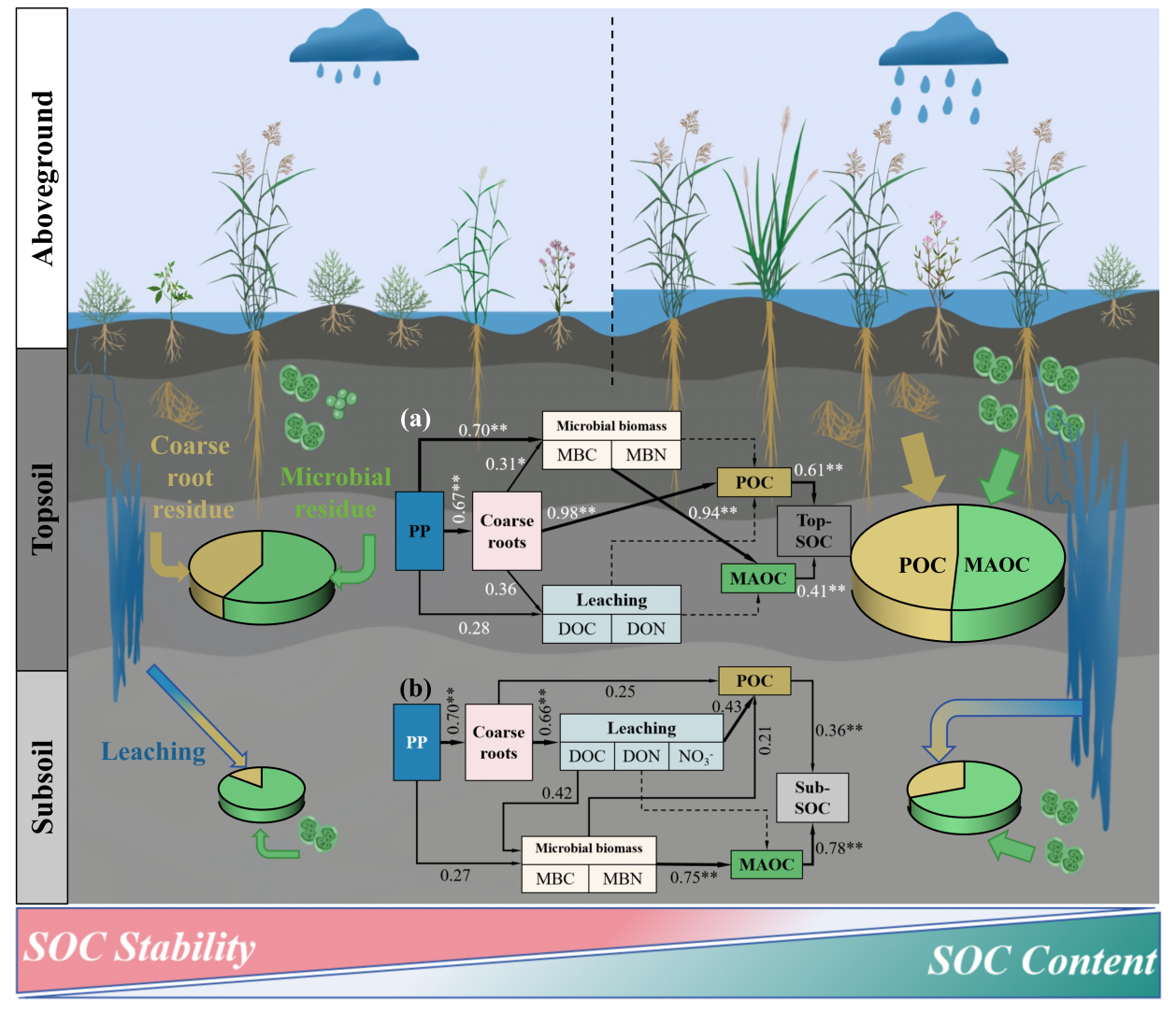
Figure 1. Conceptual diagram illustrating how precipitation change and seasonal flooding regulate net ecosystem CO₂ exchange (NEE) in a saline wetland. DP indicates decreased precipitation, and IP indicates increased precipitation; red arrows represent inhibitory effects, whereas blue arrows represent promotive effects. Another study systematically investigated how altered precipitation regulates SOC content and stability through differential responses of coarse and fine roots. The results showed that increased precipitation significantly promoted the dominance of gramineous species characterized by coarse-root systems, thereby markedly increasing coarse root biomass, whereas fine root biomass exhibited no significant variation among precipitation treatments. Compared with the control (CK), the increase in coarse roots directly enhanced particulate organic carbon (POC) accumulation in the topsoil (0-10 cm) by 37.4%, and indirectly increased mineral-associated organic carbon (MAOC) by 31.5% through stimulating microbial biomass carbon (MBC). In addition, the formation of macropores by increased coarse roots significantly facilitated the downward leaching of dissolved organic carbon (DOC) and nitrate (NO₃-), thereby promoting POC (+218.7%) and MAOC (+17.2%) accumulation in the subsoil (30-40 cm). Notably, with increasing precipitation, the MAOC/POC ratio declined from 1.65 to 1.11 in the topsoil and from 8.73 to 2.66 in the subsoil, indicating that although SOC content increased along the precipitation gradient, its relative stability decreased. These findings provide important mechanistic insights into how precipitation variability influences wetland carbon sequestration capacity and its potential climate feedbacks. The above findings were published in the international journals Catena and Environmental Science & Technology under the titles “Seasonal flooding amplifies the positive asymmetric response of ecosystem carbon exchange along the precipitation gradient in saline wetlands” and “Coarse root enhancement increases soil organic carbon while decreasing its stability in a wetland”, respectively. This research was supported by the National Natural Science Foundation of China (Grant Nos. U2106209, U2243207, 42301129, and 42401123), the National Key R&D Program of China (Grant Nos. 2022YFF0802101 and 2023YFE0113101), and the 2024 Graduate Research Innovation Project of Southwest University (Grant No. SWUB24044).
Figure 2. Effects of altered precipitation on soil organic carbon in wetlands. Li XG, Zhu WB, Zhu LQ, Song WM, Li PG, Wang XJ, Han GX*. 2026. Seasonal flooding amplifies the positive asymmetric response of ecosystem carbon exchange along the precipitation gradient in saline wetlands. CATENA 265, 109865. Liang ZH, Song J, Sun RF, Zhao ML, Wei SY, Song WM, Wang XJ, Chu XJ, Zhang XS, Jiang CS*, Han GX*. 2026. Coarse Root Enhancement Increases Soil Organic Carbon While Decreasing Its Stability in a Wetland. Environmental Science & Technology 60(2), 1831-1843. |
| Appendix Download |
|
|